
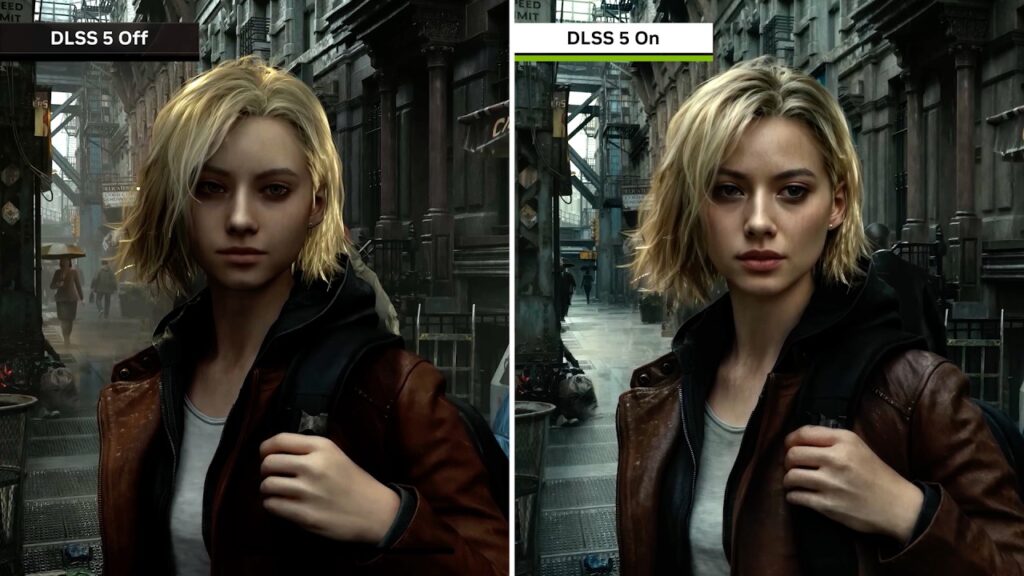
The world of PC gaming has changed forever. Indeed, the year 2026 marks a massive leap in how we see digital worlds. We no longer rely only on raw hardware power to run games. Instead, we use advanced AI to create frames and pixels. At the center of this revolution is NVIDIA DLSS 5. Specifically, this technology has redefined the limits of graphics. It does not just upscale images. Rather, it uses deep learning to build reality from scratch. Consequently, gamers are seeing levels of detail that were once impossible. This article provides an in-depth look at DLSS 5. Specifically, we will explore its groundbreaking features and its impact on the industry.
What is NVIDIA DLSS 5?
NVIDIA DLSS 5 is the fifth generation of Deep Learning Super Sampling. Unlike older versions, it is a full neural rendering suite. It was launched alongside the RTX 60-series “Blackwell Ultra” GPUs in early 2026. Specifically, DLSS 5 works by using dedicated AI processors called Tensor Cores. These cores handle the heavy math required for high-end graphics. Therefore, your GPU can focus on other tasks. Consequently, you get much higher frame rates without losing quality. In fact, in many cases, DLSS 5 looks better than the original resolution.
The Shift to Total Neural Rendering
In the past, AI only helped with upscaling. However, DLSS 5 represents a total shift. Specifically, it introduces the concept of “Neural Scene Reconstruction.” This means the AI understands the 3D space of the game. It knows where objects are and how light hits them. Furthermore, it predicts how pixels should look before they are even drawn. Consequently, this reduces the work the main GPU chip has to do. Therefore, even middle-range cards can now run games at 8K resolution with ease.
Breakthrough Features of DLSS 5
The release of DLSS 5 in 2026 introduced several massive upgrades. These features focus on realism and performance. Consequently, it is now the gold standard for gaming tech.
1. Neural Texture Compression (NTC)
The most significant update in 2026 is Neural Texture Compression. Previously, high-resolution textures took up a lot of video memory (VRAM). Now, DLSS 5 uses AI to compress these textures significantly. Specifically, it can reduce texture size by 4x without any loss in detail. Consequently, games with 8K textures can run on cards with only 12GB of VRAM. This solves the “VRAM wall” that many gamers faced in previous years.
2. Real-Time Neural Path Tracing
Path tracing was once too heavy for real-time play. However, DLSS 5 has changed that. Specifically, it uses “Neural Ray Reconstruction 2.0.” This feature uses AI to fill in the gaps in light rays. Therefore, you get perfect shadows and reflections instantly. Furthermore, it removes the “noise” often seen in ray-traced images. Consequently, games look like high-end Hollywood movies in real-time.
3. AI-Driven Frame Generation 3.0
Frame generation is now smoother than ever. Specifically, DLSS 5 can generate three frames for every one rendered by the GPU. This is powered by the new “Optical Flow Accelerator” in the RTX 60-series. Notably, it reduces input lag significantly. Therefore, playing at 240Hz feels native and responsive. As a result, competitive gamers are now using AI frames for the first time.
4. Neural Physics and Animation
A surprise feature in 2026 is neural physics. Specifically, DLSS 5 can now handle simple physics calculations using AI. For example, it can simulate hair and cloth movement. Previously, this took a lot of CPU power. Now, the AI handles it within the rendering pipeline. Consequently, characters look more life-like during fast action scenes.
DLSS 5 Compatibility and Availability
To use DLSS 5, you need the right hardware. Specifically, NVIDIA has tied the most advanced features to their latest chips. However, they have also provided some support for older cards.
1. RTX 60-Series (Full Support)
The RTX 6090 and 6080 are the primary homes for DLSS 5. Specifically, these cards have the 5th Gen Tensor Cores. These cores are required for Neural Texture Compression. Therefore, if you want the best experience, you must upgrade to the latest generation.
2. RTX 50-Series (Partial Support)
Users with RTX 50-series cards can still benefit. Specifically, they get access to the updated Frame Generation. However, they cannot use the advanced texture compression features. Consequently, it is a significant upgrade but not a full one.
3. The “Legacy” Mode for RTX 30 and 40
NVIDIA has also released a legacy driver for older cards. Specifically, it improves the basic upscaling quality. However, it does not include the neural reconstruction features. Therefore, while older cards are still supported, the gap in quality is growing wider.
DLSS 5 Pricing and Subscription Models in 2026
In 2026, NVIDIA has changed how they offer software. Specifically, DLSS 5 is free for all GPU owners. However, there are “Pro” features for creators and developers.
1. Standard DLSS 5 (Free)
This version comes with every NVIDIA driver. Specifically, it includes Super Resolution and Frame Generation. It is perfect for 99% of gamers. Notably, there are no monthly fees for basic gaming use.
2. NVIDIA GeForce Now “Ultimate” (Subscription)
If you do not own an RTX 6090, you can stream it. Specifically, NVIDIA’s cloud service now offers DLSS 5 in the “Ultimate” tier.
- Monthly Fee: $24.99.
- Features: Access to a virtual RTX 6090 with full DLSS 5 features. Furthermore, it supports 4K at 240FPS streaming. Consequently, it is a great alternative to buying expensive hardware.
3. DLSS 5 SDK for Developers
For game studios, the SDK is available through the NVIDIA Developer Program. Specifically, it allows for easy integration into Unreal Engine 6 and Unity. Therefore, we are seeing more games support DLSS 5 on day one.
Top 5 Alternatives to DLSS 5
While DLSS 5 is the leader, the market for AI upscaling is very crowded in 2026. Depending on your GPU brand, you might use a different tool. Here are the top alternatives:
- AMD FSR 4: AMD’s latest open-source competitor. In 2026, FSR 4 finally uses AI hardware on RDNA 5 cards. It is very close to DLSS in quality.
- Intel XeSS 3.0: Intel’s AI upscaler. It works across many GPU brands. Specifically, it is excellent for mobile gaming on Intel Arc laptops.
- Unreal Engine TSR: This is a built-in upscaler for Unreal Engine games. Notably, it does not require specific GPU hardware. However, it is slightly slower than DLSS.
- DirectSR (Microsoft): A unified API from Microsoft. Specifically, it allows developers to support all upscalers with one code. Consequently, it has made AI upscaling a standard feature in Windows 11.
- Apple MetalFX 2.0: For Mac gamers. It is highly optimized for M4 and M5 chips. Specifically, it allows AAA games like “Resident Evil” to run on iPads.
How DLSS 5 Integrates Into Your Gaming Experience
One of the greatest strengths of DLSS 5 is how it feels. In 2026, you don’t even need to turn it on manually in most games. Instead, it works in the background to maintain your target frame rate.
Dynamic Resolution Scaling (DRS)
For instance, if you set your target to 144FPS, DLSS 5 will adjust itself. If the scene is simple, it uses basic upscaling. However, during a big explosion, it switches to “Ultra Performance” mode. Specifically, it does this in milliseconds. Consequently, you never see a stutter. This “auto-pilot” graphics mode is perfect for console-like experiences on PC.
Reflex and Latency Reduction
Furthermore, DLSS 5 is deeply linked with NVIDIA Reflex. Specifically, it reduces the delay between a mouse click and an action on screen. In 2026, the latency is often lower with DLSS 5 on than with it off. This is because the AI reduces the queue of frames in the GPU. Consequently, the game feels more “connected” to your movements.
Energy Efficiency and Sustainability
Notably, DLSS 5 is also a “green” technology. Specifically, running a game with DLSS 5 consumes 30% less power than native rendering. This is because the AI cores are more efficient than the standard shaders. Therefore, your GPU stays cooler and your electric bill stays lower. In fact, many gaming laptops now offer a “DLSS Eco Mode” for longer battery life.
The 2026 Performance Benchmarks
In the latest 2026 benchmarks, DLSS 5 shows incredible gains. For example, in “Cyberpunk 2077: Phantom Liberty 2,” the performance jump is massive. Specifically, an RTX 6080 can achieve 120FPS at 4K with Path Tracing turned on. Without DLSS 5, that same card struggles to reach 30FPS.
Moreover, the image quality is now “Perfectly Reconstructed.” Specifically, the AI removes all aliasing and shimmering. Consequently, thin objects like power lines and fences look sharp. In the past, these were the biggest problems for upscalers. Now, they are a solved problem.
Why Some Gamers Still Hesitate
Despite its power, some people still prefer “Native” rendering. Specifically, they worry about AI “artifacts.” If the AI makes a mistake, you might see a ghosting effect behind moving objects. Consequently, this can be distracting for some users.
Furthermore, the “closed” nature of NVIDIA’s tech is a concern. Since you need an RTX card, it forces users into one ecosystem. Therefore, fans of open-source tech often prefer AMD FSR. However, NVIDIA has addressed this by improving the “Auto” mode to reduce artifacts. In 2026, most users cannot tell the difference between DLSS 5 and native 4K.
Strategies for Getting the Most Out of DLSS 5
To use DLSS 5 effectively, you should follow these steps. Specifically, focus on your monitor’s refresh rate.
First, update to the latest “Blackwell” drivers. Specifically, use the NVIDIA App instead of the old Control Panel. Second, use “Quality Mode” for 4K gaming. Specifically, this provides the best balance of looks and speed. Third, turn on “Frame Generation” only if your base frame rate is above 60FPS. This ensures the best input latency. These steps will dramatically increase your enjoyment of the latest games.
The Future: What’s Next in 2027?
Looking ahead, we expect NVIDIA to move toward “Generative Gaming.” Specifically, the AI will not just upscale the game. Instead, it might generate entire environments on the fly. For example, it could create different textures every time you play. Furthermore, we may see “Neural Voice” integration for NPCs.
Suno changed music, and Devin changed software. Now, DLSS is changing how we see reality. It is turning high-end gaming from an expensive luxury into an accessible experience. Specifically, it is democratizing high-fidelity graphics. Now, anyone with a modern GPU can see a movie-quality world.
Conclusion: Is DLSS 5 Worth the Upgrade?
NVIDIA DLSS 5 is the most capable rendering tool in 2026. Specifically, its ability to compress textures and reconstruct paths is a game-changer. It makes impossible graphics possible on consumer hardware. While it requires an RTX 60-series card for the best results, the benefits are immense.
In summary, use DLSS 5 for every modern title that supports it. Specifically, it allows you to enjoy the full beauty of Ray Tracing without the performance hit. By delegating the work to the AI, you free up your hardware for pure speed. The age of neural rendering is here. Therefore, it is time to embrace the future of graphics today.