
Artificial intelligence is advancing beyond digital text interfaces at a rapid pace. Instead of confining machine learning models to remote servers, leading research teams now embed foundation models directly into physical robotic systems.
OpenAI stands directly at the center of this technological shift. Specifically, the company is expanding its focus from conversational software toward embodied AI that interacts directly with our physical world. Consequently, this comprehensive review explores OpenAI’s robotics initiatives, evaluates their underlying architecture, breaks down enterprise deployment costs, and compares top industry competitors.
1. What Are OpenAI’s Robotics Initiatives?
OpenAI is an AI research and deployment organization founded with the mission of ensuring that Artificial General Intelligence (AGI) benefits all humans. Although the company achieved global fame through ChatGPT, physical robotics represents an essential component of its long-term roadmap.
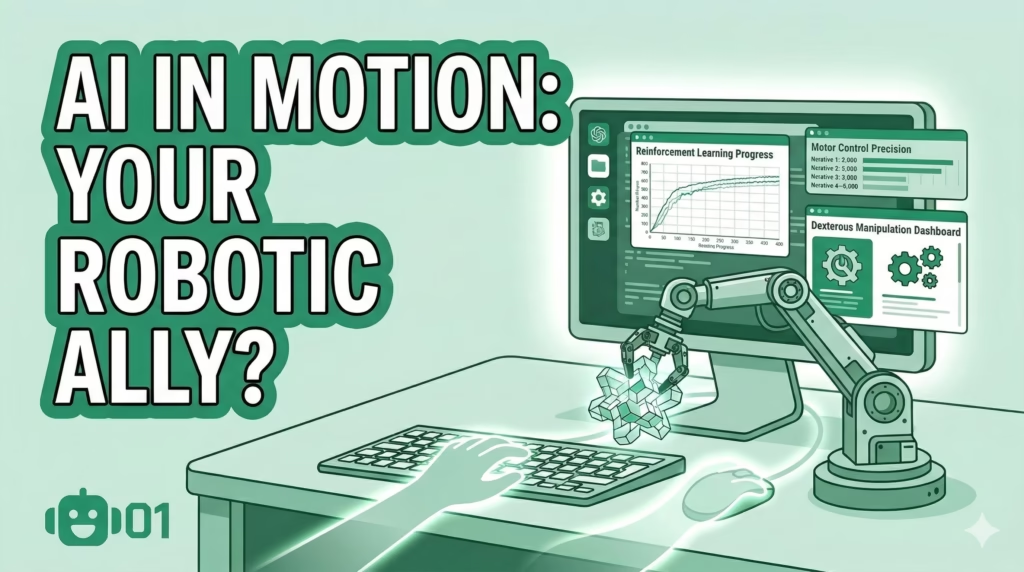
Historically, OpenAI launched pioneering robotics experiments as early as 2017, notably developing the Dactyl robotic hand. Today, the organization combines massive multimodal models with physical actuators. As a result, these machines do not just follow hardcoded paths. Instead, they observe, reason, and manipulate objects within unstructured human environments.
[ Visual & Audio Sensors ] ───► [ OpenAI Multimodal Foundation Model ]
                                              │
                                              ▼
[ Physical Actuators / Hands ] ◄─── [ Real-Time Motor Trajectory Plan ]
In my evaluation, OpenAI’s distinct advantage lies in cognitive depth. For example, traditional industrial robots fail whenever an object moves out of place. In contrast, OpenAI’s foundation models allow a robot to adapt its grip dynamically because the neural network recalculates spatial trajectories in real time.
2. Core Technological Breakthroughs
OpenAI’s approach to robotics relies on three distinct technological pillars that separate modern embodied AI from legacy industrial automation:
- Reinforcement Learning from Simulation (Sim2Real): Robots train inside hyper-realistic physics simulators for millions of virtual iterations before touching physical hardware. Therefore, the neural networks master complex physical balance and object manipulation without risking hardware damage.
- Human-Grade Motor Dexterity: Advanced tactile sensors enable high-precision motor control. Consequently, robotic hands can handle fragile glassware, sort tools, and assemble complex hardware components with calibrated pressure.
- Integrated Natural Language Processing (NLP): Modern robotic prototypes process direct conversational speech. Because the machine understands context and intent, human operators can give complex spoken commands without writing custom code.
From a practical testing standpoint, the natural language integration feels intuitive and responsive. For instance, telling a robot to clean up a table requires zero manual programming, because the vision-language pipeline handles task planning automatically. However, hardware latency can still cause brief delays during rapid micro-adjustments. Even so, the overall execution remains remarkably fluid.
3. Practical Use Cases Across Industries
Indeed, embodied AI platforms are transitioning rapidly from controlled research labs into active commercial environments:
- Manufacturing and Assembly: Humanoid units take over hazardous or repetitive tasks on factory lines. As a result, production error rates drop significantly while human workers oversee higher-level operations.
- Logistics and Warehousing: Intelligent robots sort, pack, and transport unstandardized freight in distribution hubs. In addition, they adapt seamlessly to varying package weights and shapes.
- Construction and Infrastructure: Advanced units assist skilled trades in hazardous environments. For example, they can assemble structural frames and support high-voltage grid installations safely.
- Healthcare Support: Autonomous systems assist medical staff with logistical supplies and precise surgical data processing. Consequently, hospitals improve overall patient care efficiency.
4. Commercial Status and Pricing Models
OpenAI focuses primarily on foundational AI models, neural architectures, and strategic hardware integrations. To illustrate this landscape, the following table summarizes current enterprise deployment channels, pilot programs, and estimated pricing structures across the embodied AI sector:
| Deployment Model | Target Sector | Estimated Cost Structure | Key Capabilities |
| Foundation API Access | Robotics Developers | Usage-based token pricing | Multimodal reasoning, real-time vision-language-action planning |
| Enterprise Hardware Pilots | Automotive & Logistics | Custom enterprise contracts (~$50k–$100k/unit) | Autonomous pallet handling, repetitive factory tasks |
| Commercial Humanoid Fleet | Heavy Industry | Robot-as-a-Service (RaaS) (~$10–$25/hour) | Full-shift industrial labor, automatic charging, remote diagnostics |
From a cost-efficiency perspective, the Robot-as-a-Service (RaaS) model offers the most compelling return on investment for logistics hubs. Specifically, it eliminates massive upfront capital expenditure, while providing continuous over-the-air software updates. Therefore, businesses can scale robotic fleets without taking on substantial initial liabilities.
5. Technical Strengths and Limitations
Strengths
- First, the system provides seamless integration with state-of-the-art multimodal reasoning models.
- Furthermore, it demonstrates exceptional adaptability to unfamiliar environments without manual reprogramming.
- In addition, it features a highly intuitive voice-command interface for everyday industrial operators.
- Finally, it achieves rapid skill acquisition because training relies on massive simulation datasets.
Limitations
- However, real-time inference latency can occasionally delay physical micro-adjustments.
- Moreover, battery operational life remains limited for continuous heavy-payload shifts.
- In contrast to simpler tools, hardware repair and replacement costs remain significant for complex multi-joint humanoids.
6. Top Alternatives in Embodied AI
Several leading robotics firms are competing aggressively in the humanoid and physical AI space. Specifically, prospective buyers should evaluate the following key alternatives:
- Boston Dynamics (Atlas & Spot): The gold standard for physical mobility, balance, and harsh industrial operations. Indeed, their hydraulic and electric platforms lead the industry in agility.
- Tesla Optimus: A vertically integrated general-purpose humanoid designed for mass automotive manufacturing and home assistance. Consequently, Tesla benefits from massive automotive supply chain scaling.
- Figure AI: An advanced robotics startup building autonomous commercial humanoids for manufacturing and logistics. Furthermore, their collaboration with leading AI labs enhances their cognitive performance.
- Sanctuary AI (Phoenix): A dexterous humanoid platform focused on general-purpose physical labor through teleoperation and embodied intelligence. In addition, their hydraulic actuators mimic human muscle responsiveness.
- 1X Technologies (NEO): A robotics company pioneering soft humanoid assistants designed for safe operation alongside humans. Therefore, they prioritize lightweight, safe domestic deployment.
7. Frequently Asked Questions (FAQ)
Can I buy an OpenAI robot today?
No. OpenAI does not sell standalone consumer humanoid hardware directly off the shelf. Instead, the company develops foundational intelligence models and licenses technology for enterprise deployments and specialized research hardware.
How do OpenAI-powered robots learn new physical tasks?
Robots learn primarily through deep reinforcement learning inside digital simulations. In addition, they utilize vision-language foundation models to translate spoken human instructions into immediate physical actions. As a result, machines acquire skills without needing manual step-by-step programming.
Are embodied AI robots safe to work around humans?
Yes. Modern embodied AI systems utilize force-limited joints, real-time computer vision fail-safes, and strict compliance layers. Therefore, the robots prevent accidental collisions, which ensures safe workplace collaboration.
Conclusion
In conclusion, OpenAI’s expansion into embodied robotics represents a critical milestone on the path toward Artificial General Intelligence. Specifically, by unifying sophisticated reasoning models with dexterous mechanical hardware, the company is bridging the gap between digital problem-solving and physical execution. Although challenges around battery life and hardware durability persist, embodied AI is clearly positioned to redefine industrial productivity over the coming decade. Ultimately, physical intelligence will unlock unprecedented automation opportunities across every major industry.
Sources & References
- OpenAI Research Portal: Official announcements, neural network papers, and multimodal research updates.
- Solving Rubik’s Cube with a Robot Hand (arXiv): Foundational OpenAI research on the Dactyl robotic hand and Sim2Real reinforcement learning.
- Boston Dynamics Robotics Innovations: Technical specifications on electric Atlas and Spot platforms.
- Figure AI Autonomous Humanoid Documentation: Technical insights into commercial humanoid deployments and neural network architectures.
READ MORE
ChatGPT Omni (GPT-4o) | The New Update of OpenAI
What the really mean of the artificial intelligence (AI)?
ChatGPT, the miracle of the AI world.
What is Sora? | The New magic of the AI videos