
Digital art and visual design continue to evolve at a relentless pace. Instead of relying exclusively on manual illustration or rigid prompt-only engines, creators now demand granular control over composition, character consistency, and production speed.
Leonardo.AI stands directly at the forefront of this generative shift. Specifically, the platform has grown from a specialized art generator into an enterprise-grade creative studio. Consequently, this comprehensive guide explores how Leonardo.AI works, evaluates its core technical toolset, breaks down subscription costs, and compares it against top industry alternatives.
- 1. What Exactly Is Leonardo.AI?
- 2. Behind the Platform: Origins and the Canva Ecosystem
- 3. Core Features and Technical Capabilities
- 4. Practical Use Cases Across Industries
- 5. Pricing and Subscription Plans in 2026
- 6. Step-by-Step Workflow Guide
- 7. Technical Strengths and Limitations
- 8. Top 5 Alternatives to Leonardo.AI
- 9. Frequently Asked Questions (FAQ)
- Conclusion
1. What Exactly Is Leonardo.AI?
Leonardo.AI is a full-featured generative platform designed for digital artists, game developers, and marketing teams. Unlike basic text-to-image generators, the platform provides deep control over latent space weights, art styles, and canvas compositions.
In practice, users can generate production-ready visual assets using fine-tuned neural models. Furthermore, the platform integrates advanced ControlNet pipelines and dynamic styling elements. As a result, creators achieve consistent characters, precise lighting, and studio-grade resolution without extensive manual touch-ups.
[ Text Prompt / Reference Sketch ] ───► [ Leonardo Foundation Models (Phoenix / XL) ]
                                                        │
                                                        ▼
[ High-Res Final Asset ] ◄─── [ Canvas Editor & Image Guidance Sliders ]
In my testing, Leonardo’s primary advantage lies in its workflow flexibility. For example, while other generators often feel like rigid black boxes, Leonardo equips you with direct mechanical sliders, masks, and real-time generation layers. Therefore, it bridges the gap between raw AI automation and deliberate artistic direction.
2. Behind the Platform: Origins and the Canva Ecosystem
The platform was initially founded in late 2022 by J.J. Fiasson and a team of machine learning specialists. Specifically, their initial goal was to solve asset inconsistency in game development by giving artists fine-grained control over neural outputs.
Over time, the platform experienced explosive growth across creative industries. Consequently, global design giant Canva acquired Leonardo.AI to integrate its generative capabilities into a broader creative ecosystem. Today, Leonardo continues to innovate independently through its proprietary Phoenix foundation model, which excels at complex text rendering and anatomical accuracy.
3. Core Features and Technical Capabilities
Leonardo.AI offers an extensive suite of production-focused tools:
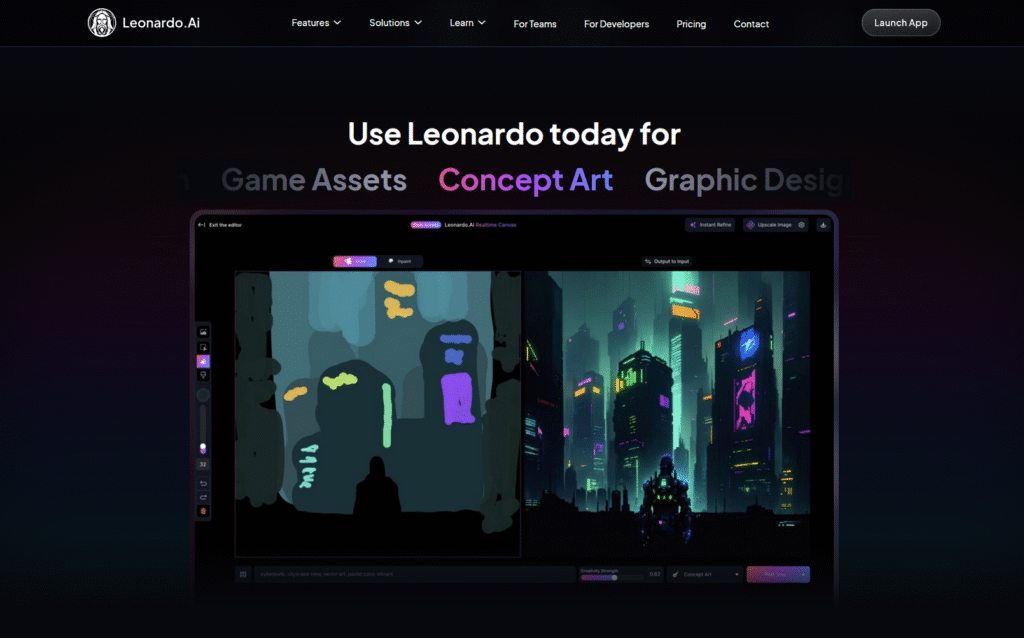
- Image Guidance & Real-Time Canvas: This engine allows creators to guide generations with reference sketches, depth maps, and edge boundaries. Therefore, you can edit compositions interactively on a unified canvas.
- Real-Time Generation (Live Canvas): This feature renders visual outputs instantly as you type prompts or paint brush strokes. Consequently, artists can brainstorm dozens of conceptual directions in seconds.
- AI Motion & Video Generation: The Motion suite transforms static 2D artwork into dynamic, high-definition video clips. Furthermore, users can control camera trajectory and motion intensity directly.
- Custom Model Fine-Tuning: Professional teams can upload reference image datasets to train bespoke LoRA models. As a result, brands maintain strict visual consistency across entire product lines.
From an interface perspective, the dashboard is exceptionally feature-dense. However, the learning curve can feel slightly steep for complete beginners. Even so, the modular layout ensures that advanced controls remain organized and accessible.
4. Practical Use Cases Across Industries
Creative professionals leverage Leonardo.AI across numerous visual disciplines:
- Game Developers & Concept Artists: Rapidly generate concept art, isometric game assets, and texture maps with consistent art direction.
- Graphic Designers & Brand Strategists: Create distinctive marketing visuals, website hero graphics, and customized typography compositions.
- Architects & Interior Designers: Render realistic 3D space concepts and atmospheric lighting mockups from simple volumetric sketches.
- Content Creators & Video Editors: Produce animated promotional teasers and stylized channel assets using the integrated Motion engine.
5. Pricing and Subscription Plans in 2026
Leonardo.AI utilizes a tiered token-based pricing system. Specifically, free tiers provide a daily allowance of renewable tokens, whereas paid subscriptions offer monthly token reserves, priority generation speed, and privacy features.
| Plan | Monthly Price | Monthly Tokens | Key Inclusions |
| Free Tier | $0.00 | 150 daily tokens | Standard models, public generations |
| Apprentice | ~$12.00 | 8,500 / month | Priority generation, no queue, concurrent jobs |
| Artisan | ~$30.00 | 25,000 / month | Private generations, advanced models, custom LoRA training |
| Maestro | ~$60.00 | 60,000 / month | Maximum rendering speed, full video generation suite, team access |
From a price-to-performance perspective, the Artisan Plan delivers the best overall value for commercial designers. Specifically, it includes private creation mode and sufficient token capacity for high-volume monthly workflows. Therefore, professional studios can scale production without worrying about strict daily limits.
6. Step-by-Step Workflow Guide
Getting started with Leonardo.AI involves three practical steps:
- Create an Account: First, navigate to Leonardo.ai and register using your Google or Apple credentials.
- Select Model & Elements: Next, choose a base model such as Leonardo Phoenix or Vision XL, and attach stylistic elements like “Concept Art” or “Isometric.”
- Prompt and Iterate: Afterward, type your prompt into the generation bar, adjust guidance weight sliders, and generate your batch. Finally, use the built-in upscaler to produce high-resolution assets.
7. Technical Strengths and Limitations
Strengths
- First, it delivers industry-leading control through multi-layer image guidance and inpainting.
- Furthermore, it enables instantaneous visual feedback via real-time canvas tools.
- In addition, it supports proprietary model fine-tuning for unique brand styling.
- Finally, it features robust commercial usage policies on paid plans.
Limitations
- However, token consumption increases rapidly when generating video or performing 4K upscaling.
- Moreover, the multi-feature dashboard requires time to master compared to simple prompt-only tools.
- In contrast to the desktop web app, the mobile client offers a more limited set of advanced editing tools.
8. Top 5 Alternatives to Leonardo.AI
If your creative pipeline requires different specialized workflows, consider these top industry alternatives:
- Midjourney: The premier benchmark for photorealistic textures, atmospheric lighting, and artistic rendering. Indeed, it remains the top choice for cinematic illustrations.
- DALL-E 3: An intuitive generator integrated into ChatGPT, excelling at direct prompt interpretation. Consequently, it is ideal for rapid prototyping.
- Adobe Firefly: A commercially safe generative engine natively integrated into Photoshop and Illustrator. Therefore, it fits enterprise graphic workflows seamlessly.
- Stable Diffusion: An open-source ecosystem suited for developers seeking local hardware deployment and custom checkpoint control.
- Playground: A collaborative cloud-based canvas platform optimized for graphic designers and digital marketers.
9. Frequently Asked Questions (FAQ)
Does Leonardo.AI allow commercial use of generated assets?
Yes. Paid subscription plans grant full commercial ownership of generated outputs, because the terms allow deployment in commercial products, game assets, and client campaigns.
How does Leonardo.AI compare to Midjourney?
Midjourney focuses heavily on artistic interpretation from textual prompts. In contrast, Leonardo.AI functions as a production workspace with granular sliders, image guidance, and real-time canvas editing.
Can I keep my generations private?
Free-tier creations are published automatically to the community feed. However, you can toggle private generation mode by upgrading to the Artisan or Maestro tier.
Conclusion
In conclusion, Leonardo.AI stands as one of the most versatile and capable generative platforms in the modern AI landscape. Specifically, by bridging the gap between raw neural synthesis and hands-on artistic control, it empowers professionals to produce consistent, production-ready assets with ease. Although mastering its deep feature set takes practice, Leonardo remains an indispensable asset for designers, game studios, and digital content creators worldwide. Ultimately, it provides the exact balance of speed, control, and precision required for modern digital art production.
Sources & References
- Leonardo.AI Official Platform: Official workspace, generation suites, and documentation.
- Leonardo.AI Platform FAQ & Guides: Technical details on model architectures, token systems, and commercial licensing.
- Canva Newsroom: Leonardo.ai Integration: Official release regarding platform integrations and technological roadmap.
- High-Resolution Image Synthesis with Latent Diffusion Models (arXiv): Foundational research on latent diffusion architectures by Rombach et al.
READ MORE
DALL-E | Know The MAGIC art of the AI World