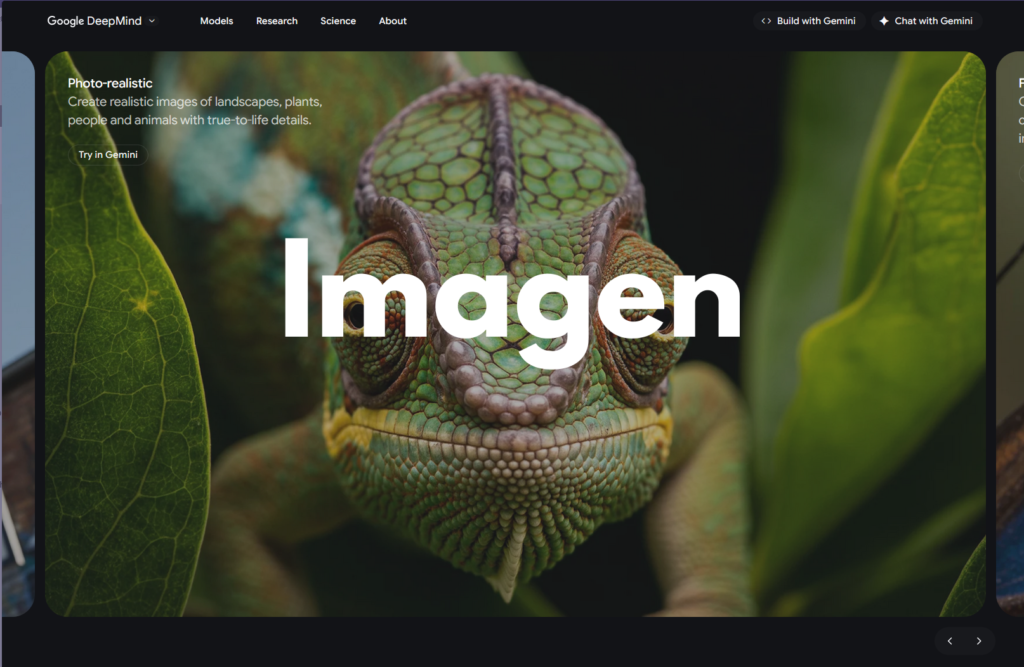
Google Imagen: The Best and powerful Google’s Artist AI

As you explore the fast growing realm of artificial intelligence, you may have come across Google Imagen. This cutting-edge AI picture generator has caught the interest of both tech enthusiasts and creative pros. In this article, you’ll learn about Imagen’s beginnings, accessibility, and the revolutionary technology that drives its astonishing powers. You will also learn about price structures, use restrictions, and the benefits and drawbacks of adopting Imagen into your workflow. You’ll also look at other possibilities in the AI picture generating landscape, allowing you to make more educated decisions about how to use this disruptive technology in your projects

Google Imagen

Introducing Google Imagen: The Future of AI Image Generation.

Google’s Imagen marks a significant advancement in AI-powered picture generating technology. This cutting-edge application uses artificial intelligence to generate amazingly realistic graphics from verbal descriptions, pushing the limits of what is possible in visual content production.

How Google Imagen Works

At its heart, Google Imagen employs a sophisticated text-to-image diffusion algorithm. This AI picture generator converts textual input into highly detailed, lifelike graphics. Imagen uses powerful machine learning techniques to read complicated descriptions and depict them with astonishing precision.

Unparalleled Image Quality

What distinguishes Imagen from other AI picture generators is its capacity to generate photos of remarkable quality. The system excels in capturing fine details, textures, and lighting effects, producing images that are frequently indistinguishable from those taken by human photographers.

Versatility and Applications

Imagen’s powers go much beyond mere picture production. Its potential uses cover a variety of sectors, including:

  • Advertising and Marketing
  • Product Design and Prototyping
  • Film and video game production.
  • Architectural visualization

The Future Of Visual Content Creation

As Google improves and expands Imagen’s capabilities, we should expect even more spectacular outcomes in the future. This technology has the ability to transform how we approach visual content production, opening up new opportunities for artists, designers, and companies alike.

While Imagen is not yet widely available to the general public, its development represents an exciting shift in the landscape of AI-powered creation. As this technology advances, it will likely redefine our concept of what is feasible in the field of digital imaging.

Who Created Google Imagen, and Why?

Google’s Imagen, a revolutionary AI picture generator, was created by the company’s Brain Team, a team committed to pushing the limits of artificial intelligence and machine learning. This cutting-edge technology resulted from Google’s continuing efforts to transform computer vision and natural language processing.

The Brains Behind Innovation

Google’s Imagen was developed by a team of talented academics and engineers from Google’s AI department. These specialists used their expertise of deep learning algorithms, neural networks, and computer vision to create this new technology.

Driving Forces Behind Google Imagen Development

  • Google’s motivations for creating Imagen were diverse.
  • Increasing AI capabilities: By developing a more complex picture production tool, Google hoped to push the limits of what AI can accomplish in visual content creation.
  • Improving creative processes: Imagen was created to help artists, designers, and content producers bring their ideas to life with more efficiency and precision.
  • Improving accessibility: The team aimed to democratize high-quality picture production, allowing anyone without considerable artistic abilities to produce beautiful graphics.

The Technological leap

Imagen marks a big leap in the field of AI-powered picture production. Google engineers developed a system that generates amazingly accurate and detailed pictures from text descriptions by combining huge language models and diffusion techniques.

This discovery not only demonstrates Google’s dedication to innovation, but also offers up new opportunities in a variety of industries, including advertising, entertainment, education, and scientific visualization. As technology advances, we should expect to see even more fascinating applications for Google’s Imagen in the future.

Capabilities of Google Imagen: What Can This AI Do?

Google’s Imagen, a cutting-edge AI picture generator, has an outstanding set of features that push the limits of artificial intelligence in visual content production. This amazing application uses advanced machine learning techniques and large datasets to generate breathtakingly realistic and creative graphics from text descriptions.

Text to Image Synthesis

At its foundation, Imagen excels at converting textual suggestions into vibrant, high-resolution visuals. Users may provide precise descriptions, and the AI will produce graphics with astonishing accuracy. This tool gives up limitless possibilities for artists, designers, and content creators who want to bring their ideas to life swiftly and effectively.

Photorealistic Rendering

One of Imagen’s most notable advantages is its ability to produce photorealistic pictures that are frequently indistinguishable from real photographs. This capacity has important ramifications for businesses that require lifelike graphics, such as advertising, cinema, and virtual reality.

Style versatility

Imagen is extremely versatile in recreating numerous creative styles and methods. From oil paintings to digital art, the AI can replicate a broad spectrum of visual aesthetics, making it an invaluable tool for artists looking for inspiration or experimenting with new techniques.

Complex Scene Generation

The AI picture generator excels at producing complex, multi-element sceneries. It can smoothly merge different items, people, and backgrounds to create visually appealing compositions. This tool is very beneficial for storyboarding, concept art, and world-building in the creative professions.

Users may utilize Google’s Imagen to explore new horizons of visual creativity and streamline their content production processes.

How Does Google Imagen Work? The Science Behind Magic

Google’s Imagen, a cutting-edge AI picture generator, uses powerful machine learning algorithms to generate amazing graphics from written descriptions. This revolutionary technique represents a substantial advancement in the fields of artificial intelligence and computer vision.

Text to Image Synthesis

At its foundation, Google’s Imagen uses a powerful text-to-image synthesis algorithm. When you enter a text prompt, the AI analyzes and understands the language, separating it into important concepts, objects, and properties. It then applies this expertise to create comparable visual elements.

Diffusion and Large Language Models

Imagen utilizes both diffusion models and big language models. Using text as input, the diffusion model gradually refines a chaotic picture into a clear, detailed representation. Meanwhile, the huge language model interprets and contextualizes the text prompt, resulting in a more accurate visual display.

High-resolution image generation

One of Imagen’s most notable characteristics is its capacity to generate high-resolution photos. The AI takes a cascade method, beginning with a low-resolution image and gradually improving it to produce clear, detailed graphics. This multi-step approach enables the creation of complex sceneries with exquisite features.

Continuous Learning and Improvement.

Google’s Imagen, like many other AI systems, is meant to learn and improve with time. As it processes more text-to-image queries, it improves its knowledge of language and visual ideas, resulting in more precise and spectacular outputs.

By integrating these sophisticated approaches, Google’s Imagen expands the possibilities for AI-generated photography, providing a formidable tool for both creative pros and hobbyists.

Pricing and Accessibility: Who Can Use Google Imagen?

Google’s Imagen, a cutting-edge AI picture generator, has sparked widespread interest in the IT world. However, its accessibility and cost structure are still a mystery. Let’s learn more about who can utilize this smart technology and how much it may cost.

Limited availability.

Google’s Imagen is now unavailable to the general audience. The corporation has kept the technology completely under wraps, relying on it mostly for internal research and development. This restricted access is due in part to ethical concerns and the need to further enhance the AI model.

Potential Future Access.

While Google has not revealed specific plans for public release, industry analysts believe Imagen will eventually be incorporated into existing Google services or sold as a standalone product. This might possibly provide access to developers, entrepreneurs, and creative professions.

Pricing Considerations:

There is no official pricing information for Google Imagen because it is not yet commercially accessible. However, given the sophistication of this AI technology, it is reasonable to expect that when it is published, it will use a tiered pricing plan similar to other advanced AI services.

Basic level: Potentially free or low-cost for limited use.

Professional tier: A more expensive choice with additional features and generating capacity.

Enterprise tier: customized pricing for large-scale applications.

Access to Google’s Imagen is likewise limited due to worries about potential abuse. Copyright infringement, the production of deepfakes, and the fabrication of improper content are all being carefully reviewed before a broader distribution.

As AI technology advances, the accessibility and affordability of tools such as Google’s Imagen will most certainly change to fulfill commercial needs while also addressing ethical issues. For the time being, we can only imagine how transformational this picture generator will be once it is more publicly available.

See The Prices From Here

Step-by-Step Guide for Using Google Imagen

Google’s Imagen, an advanced AI picture generator, has transformed the way we produce visual content. While it is not yet publicly available, understanding its potential process will help you plan for when it becomes available. Here’s a possible instruction for using this powerful tool:

  1. Access the Platform.

To begin using Google Imagen, you will most likely need to use a specific platform or interface. This might entail connecting into a Google account or a dedicated page geared for AI picture production.

  1. Craft Your Prompt

The essence of employing an AI picture generator is to create an effective prompt. With Imagen, you would enter a full written description of the image you wish to produce. Be explicit about the theme, style, colors, and composition.

  1. Adjust settings.

Before creating your image, you may have the ability to fine-tune several variables. This might include image resolution, creative style, or the degree of photorealism you like.

  1. Generate and refine.

Once you’re pleased with your prompt and settings, you may start the picture generating process. Imagen will then utilize powerful AI algorithms to generate a picture based on your criteria. You may be able to obtain your desired outcome by generating numerous alternatives or making incremental improvements.

  1. Download and use.

After producing a picture that satisfies your requirements, you will be able to download it in your selected format. Remember to follow any usage rules or license conditions established by Google for photos made using Imagen.

By following these instructions, users may utilize Google’s Imagen to generate spectacular, one-of-a-kind graphics for a variety of purposes, including digital art and marketing materials.

Benefits of Google Imagen: Revolutionizing the Visual World

Google’s Imagen, a cutting-edge AI picture generator, has several benefits that are revolutionizing the visual scene. This breakthrough technology uses powerful machine learning algorithms and Google’s massive picture collection to generate breathtaking, high-quality images from text descriptions.

Unparalleled Google Imagen Quality

One of the most notable benefits of Google’s Imagen is its capacity to produce very detailed and lifelike photographs. The AI-powered system excels at catching complex textures, lighting, and composition, producing images that are frequently indistinguishable from those produced by expert photographers.

Versatile and creative

Imagen’s versatility enables users to create a wide range of visual material, including landscapes and portraits, abstract notions, and magical sceneries. This adaptability makes it an important tool for artists, designers, and content makers, allowing them to bring their craziest ideas to life with remarkable ease.

Time and Cost Efficiency

Google’s Imagen automates the picture generation process, drastically reducing the time and resources necessary for visual content development. This efficiency is especially useful for organizations and marketing teams who require big amounts of original graphics for their campaigns and projects.

Accessibility and democratization

Imagen’s user-friendly interface allows those with limited technical or creative abilities to create complex images. This democratization of visual content creation creates new avenues for creative expression and communication across several sectors and industries.

Continuous Improvement.

As an AI-powered tool, Google Imagen is continually learning and improving. With each usage, the system improves its grasp of visual ideas and written cues, producing increasingly accurate and remarkable outcomes. This constant development guarantees that consumers will always have access to cutting-edge picture production capabilities.

Potential drawbacks and limitations of Google Imagen

While Google’s Imagen marks a big advancement in AI picture production, it is critical to understand its possible disadvantages and limits. Understanding these obstacles can help users make more educated decisions about how to incorporate this technology into their processes.

Ethical considerations and bias

As with many AI systems, Google’s Imagen may unintentionally perpetuate social prejudices seen in its training data. This might result in the creation of pictures that perpetuate prejudices or underrepresent specific communities. Users should be aware of potential biases and closely assess the results.

Limited accessibility.

Google’s Imagen is now unavailable to the general audience. This restricted access restricts its potential influence and hinders a wide range of consumers from utilizing or offering input on the technology. The absence of broad testing may also impede the detection and resolution of possible problems.

Technical Limitations

Despite its excellent skills, Google Imagen may fail to handle complicated concepts or very specific requests. Users may notice that the AI picture generator has trouble properly displaying fine features, maintaining consistent styles across numerous generations, or comprehending subtle requests.

The usage of AI-generated photographs poses issues about copyright and ownership. It’s unclear how existing copyright regulations apply to photographs made by Google’s Imagen, which might lead to legal issues for people who utilize these images in their work.

Dependence on text prompts

Imagen depends primarily on text prompts to create pictures. This reliance may restrict its use for users who struggle to express their visual concepts in words or who prefer more intuitive, visual-based input techniques.

By taking into account these possible negatives, users may approach Google’s Imagen in a balanced manner, exploiting its capabilities while remaining aware of its limits.

Google Imagen vs. Alternatives: Comparing the Best AI Image Generators

In the fast changing environment of AI picture production, Google’s Imagen stands out as a leading contender. However, it is not the only participant in this dynamic industry. Let’s look at how Imagen compares to other top AI picture producers and what distinguishes it.

Google Imagen Unique Strengths

Google’s Imagen has outstanding skills for creating extremely detailed and lifelike pictures from text descriptions. Its capacity to recognize and interpret complicated requests distinguishes it from many alternatives. Imagen’s output frequently exhibits amazing consistency and adherence to the provided language, making it a valuable tool for both creative individuals and enterprises.

Comparing features and accessibility.

While Imagen demonstrates Google’s expertise in AI technology, other systems such as DALL-E , Midjourney, and Stable Diffusion have their own distinct qualities. Some alternatives may offer better user-friendly interfaces or more accessibility to the public. It’s worth mentioning that Imagen’s availability is currently limited compared to some of its rivals.

Performance and Output Quality

When it comes to picture quality and accuracy, Google Imagen regularly delivers excellent results. However, various AI picture producers have their own set of strengths. For example, some may specialize in certain art styles or provide additional personalization choices. The user’s particular demands and preferences frequently influence his or her decision between Imagen and its competitors.

Ethical Considerations and Limitations

As with any AI picture generator, it is critical to address the ethical implications and any biases in the results. Google has taken measures to address these problems with Imagen, but users should be aware of the restrictions and responsibilities associated with utilizing any AI-powered picture production tool.

Conclusion

As you learn more about Google’s Imagen, it becomes evident that this AI picture generator marks a substantial advancement in text-to-image technology. While access is currently limited, Imagen’s potential to alter creative workflows across sectors is apparent. As with any strong new instrument, it is critical to weigh both the thrilling possibilities and the possible downsides. Whether Imagen becomes your go-to picture production solution or you choose another, remaining updated about these fast changing AI technologies is critical. Understanding technologies like Imagen can help you better leverage the potential of artificial intelligence in your own creative and professional activities.


Read More

Leonardo AI | The Hidden Secret In AI Art World

Craiyon | The New Artist in Artificial Intelligence World

DALL-E | Know The MAGIC art of the AI World

Midjourney the magic of the AI art world

Leave a Comment